
JEHO BV AEROELASTIC Tools
Aeroelastic Tool WAF1C
At JEHO BV we are also actively developing software. The first tool we have developed is aimed at being used in the wind turbine aeroelasticity training that we provide. It is called WAF1C (pronounce: wafic; Work of Aerodynamic Forces in 1 cycle).
The tool calculates the aerodynamic work done in one cycle of a blade mode, where the blade mode shape in three directions as well as the phase differences between these three directions are provided as input, together with wind speed, pitch angle, blade chord and twist, aerofoil distribution, aerodynamic coefficient tables and frequency.
purely out-of-plane), in-plane and torsion during one cycle of the mode. Several results can be evaluated: the total work done (if positive, the mode is unstable), the angles of attack along the different radial points during the cycle etc. You can try to find out what the effect is of the different phase angles: if the mode motions are all in phase they will reach maximum amplitude at the same time, if there is a 90 degree difference, the maximum of one direction will occur when in the other direction the amplitude will be zero. Phase differences are not always taken into account in aeroelastic evaluation tools, but they have very large effects on the final damping and can provide very illustrative results when trying to understand why vibrations are occurring on wind turbine blades. The phase differences are caused by the aerodynamic forces.
The tool is used during the courses, to illustrate different properties that affect aerodynamic damping, but if you are interested in obtaining a license for this tool, please feel free to contact us! You can reach us by e-mail: info “@” jeho . nl


An example obtained using the tool is shown above. This shows what is often the case, the out-of-plane motion has a lot of damping (so negative work done by the aerodynamic forces) while the in-plane motion is unstable. Of course the sum of these contributions (and torsion contribution if applicable) provides the total work done for the inputted mode shape and therefore the outcome: aerodynamic forces provide damping for this mode or result in an instability.

Extended WAF1C
The WAF1C tool has been extended to be used as a tool to get very quick insight into some values that can be particularly useful for solving idling instabilities.
You can enter a range of wind speeds, a range of misalignment angles, a range of flow inclination angles and a range of azimuth angles and obtain the angles of attack along the blades as well as the torque that is produced. Both are especially interesting if you have issues with idling cases. The angle of attack is often related to the cause of the instability and a lack of rotation of the rotor can result in the rotor remaining at an unstable situation for longer than one would like.

Example plot for the torque for different azimuth angles and different misalignment angles. With this one can quickly change some of the properties of the blade design and get an idea of the effect this will have on the torque and provide ideas of what changes would be more effective in case of an instability.
Example plot showing the angles of attack along the blade for different azimuth angles. Knowing for which angles of attack negative stall or positive stall occurs, can help in quickly identifying changes that may help reduce the idling loads.
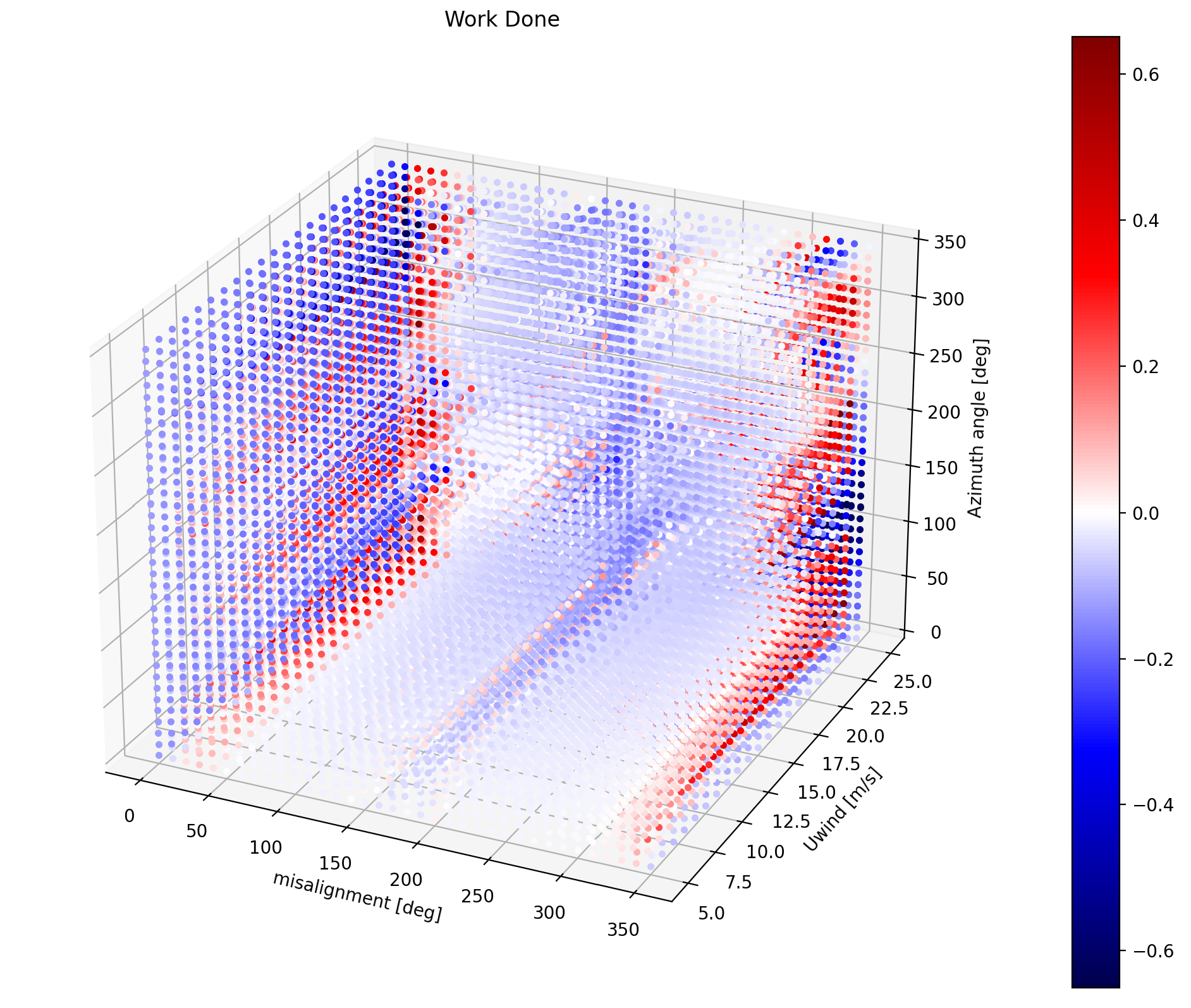
The tool can also evaluate the work done during 1 cycle for one full rotor mode, for the entire set of input that has been provided. This can also easily be plotted as can be seen in the example plot below on the left, showing the work done during one cycle for a small amplitude vibration in edgewise direction while idling at 0.1 rpm.
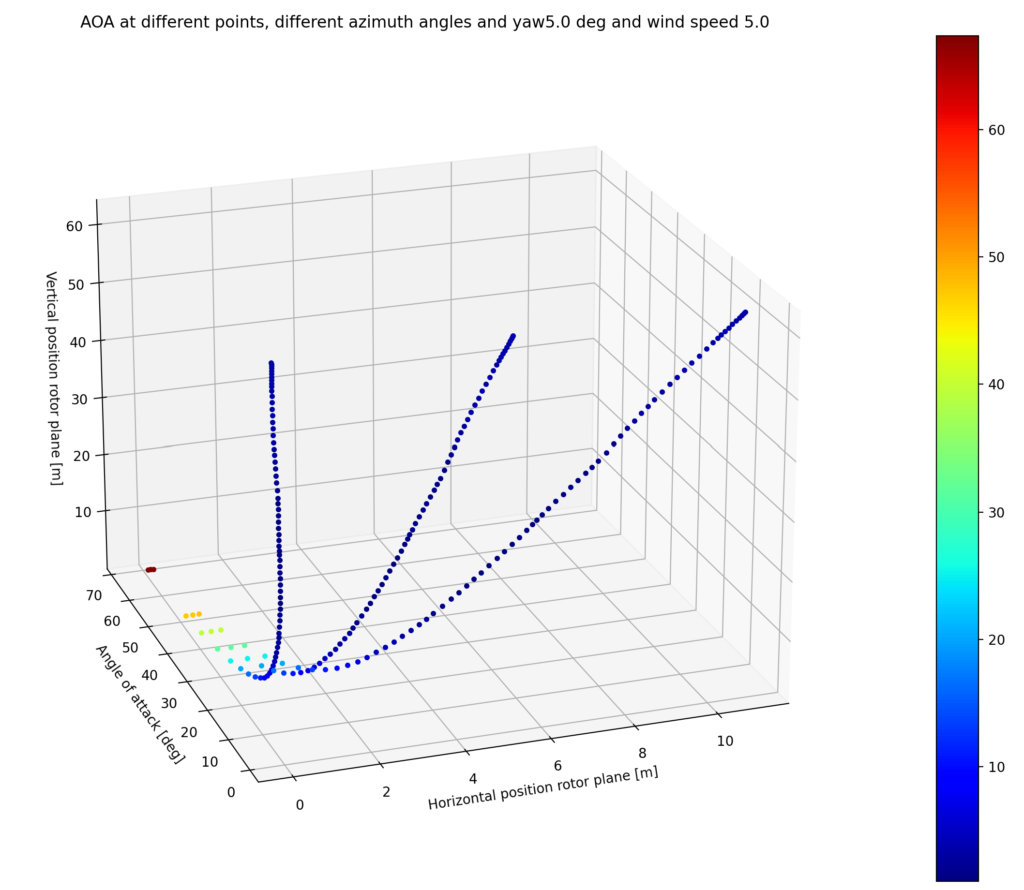
The tool is supplied with several example Python codes that can be used to create different plots, such as the ones shown above and more. Of course the 3D plots can be rotated, so that you can more easily find possible issues.
Tool development for clients
We are also available for client specific tool development, so if you require a certain adjustment or extension to current tools or a new tool to calculate something that has to do with wind turbine aeroelasticity or dynamics, please feel free to contact us to discuss what we could offer. We have experience in different programming languages and in tools such as FAST, OpenFAST, Aerodyn, Beamdyn, Simpack, WOBBE, PHATAS, FOCUS, Blademode, and much more. Also an extensive background in 3-D dynamics allows us to solve all kind of dynamic issues quickly. You can reach us by e-mail: info “@” jeho . nl